
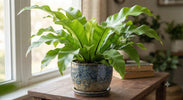
Fern Care
, 20 min reading time
, 20 min reading time
Ferns are popular houseplants that bring a touch of greenery and freshness into your home. With their graceful leaves and lush growth, they are a beautiful addition to any room. Ferns come in various types, each with its own unique characteristics and care requirements. In this blog, we dive deep into the world of ferns and give you all the information you need to keep your ferns healthy and happy.
There are many different types of ferns, each with unique characteristics and requirements. Some popular fern species that we offer at Planten247 are:
View our full range or read more about each species to find the perfect fern for your space.
Watering is crucial for the health of your fern. Ferns are plants that naturally grow in moist, shady environments, such as in the undergrowth of forests. They thrive in a moist environment but cannot tolerate standing water. Finding the right balance in watering is essential to keep your fern healthy, green, and lush. Overwatering can lead to root rot, while too little water can cause the leaves to wilt and turn brown. In this section, we discuss how often to water your fern, how to check if your fern needs water, and provide tips for misting your fern. data-sizes="auto" data-src="https://cdn.shopify.com/s/files/1/0804/7319/4829/files/Varen_Water_Geven.jpg?v=1722252672" data-srcset="https://cdn.shopify.com/s/files/1/0804/7319/4829/files/Varen_Water_Geven_1800x.jpg?v=1722252672 1800w, https://cdn.shopify.com/s/files/1/0804/7319/4829/files/Varen_Water_Geven_1600x.jpg?v=1722252672 1600w, https://cdn.shopify.com/s/files/1/0804/7319/4829/files/Varen_Water_Geven_1400x.jpg?v=1722252672 1400w, https://cdn.shopify.com/s/files/1/0804/7319/4829/files/Varen_Water_Geven_1200x.jpg?v=1722252672 1200w, https://cdn.shopify.com/s/files/1/0804/7319/4829/files/Varen_Water_Geven_1000x.jpg?v=1722252672 1000w, https://cdn.shopify.com/s/files/1/0804/7319/4829/files/Varen_Water_Geven_800x.jpg?v=1722252672 800w, https://cdn.shopify.com/s/files/1/0804/7319/4829/files/Varen_Water_Geven_600x.jpg?v=1722252672 600w, https://cdn.shopify.com/s/files/1/0804/7319/4829/files/Varen_Water_Geven_400x.jpg?v=1722252672 400w">
The frequency with which you should water your fern depends on various factors such as the type of fern, the pot size, the ambient temperature, and the humidity in your home. Generally, ferns need water one to two times a week. During the winter months, when growth slows, you can reduce watering. Keep in mind that the top layer of potting soil may dry out slightly between waterings, but the soil must never dry out completely.
Checking the moisture of the potting soil is a simple way to determine if your fern needs water. Stick your finger about 2-3 cm into the potting soil. If the soil feels dry, it is time to water. You can also use a moisture meter for a more accurate measurement. Ensure the pot has good drainage to prevent water from accumulating at the bottom of the pot, which can cause root rot.
In addition to watering, many ferns also like regular spraying. This helps to increase the humidity around the plant, which is essential for their growth and health. Spraying can be especially important during the winter months when the air in the house is drier due to heating.
The right location is essential for the health and growth of your fern. Ferns are accustomed to the shady and damp environments of forests and thrive best in similar conditions indoors. Finding the perfect spot for your fern can make a big difference in how well the plant grows and blooms.
Ferns love a bright spot with indirect sunlight. Direct sunlight can burn the delicate leaves, while too little light can hinder growth. A spot by a north- or east-facing window is often ideal. Here they get sufficient light without being exposed to the bright midday sun.
Ferns can be placed outside during the summer months, but ensure that they are in the shade and protected from direct sunlight and strong winds. Bring the fern indoors before temperatures drop too much in the autumn.
If you notice that your fern is not getting enough light, you can consider placing it closer to a window or using grow lights. These lights can help meet your fern's light needs, especially during the dark winter months.
With too much light, the leaves of your fern can discolor and burn. Move your fern to a spot with less direct sunlight, such as further away from the window or behind a translucent curtain.
With the right location, your fern will flourish and be a beautiful, lush addition to your interior. By taking into account their natural preferences for light, temperature, and humidity, you ensure that your fern can develop to its full potential.
Ferns grow quickly and occasionally need a new pot to continue growing. Repotting ensures that the roots have sufficient space and access to fresh nutrients, which is essential for a healthy plant. In this section, we discuss when and how best to repot your fern.
It is best to repot your fern every 1-2 years, preferably in the spring when the growth phase begins. This is the time of year when the plant actively produces new roots and leaves, allowing them to adapt more quickly to their new environment.
Repotting can be a simple process if you follow the right steps. Here is a step-by-step guide:
1. Preparation:
2. Removing the Fern from the Current Pot:
3. Inspecting and Pruning Roots:
4. Placing in the New Pot:
5. Watering:
6. Aftercare:
Fertilization is essential to keep your fern healthy and strong. Ferns need nutrients to grow well and remain lush green. In this section, we discuss how and when it is best to fertilize your fern, and which type of fertilizer is most suitable.
Ferns usually need extra nutrients during their growing season, which runs from early spring to late summer. During this period, you can fertilize your fern every 4-6 weeks. In autumn and winter, when the plant is dormant, you can reduce or stop fertilization altogether, as growth slows down then.
Use a balanced, water-soluble fertilizer or a liquid houseplant fertilizer. A fertilizer with an N-P-K ratio of, for example, 20-20-20 is suitable for ferns. This ratio indicates that the fertilizer contains equal parts nitrogen (N), phosphorus (P), and potassium (K), which contributes to balanced growth.
1. Preparation of the Fertilizer:
2. Applying the Fertilizer:
3. Aftercare:
The right potting soil is essential for a healthy fern. Ferns need well-draining and moisture-retaining potting soil to grow optimally. An ideal potting mix for ferns consists of peat moss, perlite, leaf mould, and finely ground bark. Peat moss retains moisture without becoming waterlogged, perlite ensures good drainage, leaf mould adds nutrients, and bark improves soil structure. If you do not have time to make your own mix, choose ready-made potting soil specifically formulated for ferns or epiphytic plants. Ensure the pot has good drainage holes to drain excess water and use a pot that matches the size of the fern to prevent root rot.
Ferns are beautiful, lush plants that bring a touch of greenery and freshness to any interior. Propagating ferns is a great way to expand your plant collection at no extra cost. In this guide, you will learn how to propagate and care for ferns in a simple way.
Before you begin, make sure you have the following materials on hand:
The best time to take cuttings from ferns is in spring or early summer, when the plant is actively growing. This increases the chance of successful rooting and growth.
Choose a healthy and strong mother plant with sufficient roots and leaves. Water the plant a few days in advance so that the roots are well hydrated.
Look for offshoots or small plants (pups) at the base of the mother plant. These offshoots often already have small roots. Carefully cut the offshoots from the mother plant with a sharp and clean knife or scissors. Ensure that part of the roots remains attached to the cutting.
Fill the pots or planters with airy and well-draining potting soil suitable for ferns. Make a small hole in the potting soil and place the cutting in it. Lightly press the soil around the cutting to hold it in place.
Ferns love a humid environment. Cover the pots with clear plastic bags or place them in a propagator to create a mini-greenhouse effect. This helps to keep the humidity high, which is essential for root formation.
Place the cuttings in a bright spot, but avoid direct sunlight, as this can burn the young plants. Ensure that the potting soil is always slightly moist, but not waterlogged. Use a mister to spray the cuttings regularly and keep the humidity high.
It may take several weeks for the cuttings to form sufficient roots. Be patient and continue to ensure a humid environment. As soon as the cuttings start forming new leaves, this means they are well rooted.
When the new ferns are strong enough and well rooted, you can repot them into a larger pot or their final location in your home or garden. Continue caring for the plants by watering regularly and misting them occasionally to keep humidity high.
With these steps, you can easily propagate your own ferns propagate and enjoy a lush green oasis in your home or garden. Good luck!
De meeste varens zijn niet giftig, maar het is altijd goed om te controleren voordat je een nieuwe plant in huis haalt. Bepaalde soorten varens zijn echter wel giftig. Pas hierbij op met kinderen en huisdieren. Neem bij inname of twijfel altijd contact op met de huis-/dierenarts.
Het snoeien van varens is belangrijk voor hun gezondheid en groei. Hier zijn de stappen die je kunt volgen om varens op de juiste manier te snoeien:
1. Benodigdheden:
2. Timing:
3. Verwijder dode of beschadigde bladeren:
4. Dunnen van de plant:
5. Vorm geven:
6. Onderhoud:
7. Verzorging na het snoeien:
Door deze stappen te volgen, zorg je ervoor dat je varens gezond blijven en goed blijven groeien.
Bruine of gele bladeren bij een varen kunnen verschillende oorzaken hebben. Hier zijn enkele veelvoorkomende redenen en hoe je ze kunt oplossen:
1. Onvoldoende Water:
2. Te Veel Water:
3. Luchtvochtigheid:
4. Directe Zon:
5. Temperatuurschommelingen:
6. Voedingsgebrek:
7. Plaag- of Ziekteinfecties:
Door de oorzaak te identificeren en de juiste maatregelen te nemen, kun je de gezondheid van je varen herstellen en toekomstige problemen voorkomen.


